ACCESSING CLASSIFIED FILES
Decrypting documents...
Your connection is being monitored
ACCESSING CLASSIFIED FILES
Decrypting documents...
Your connection is being monitored
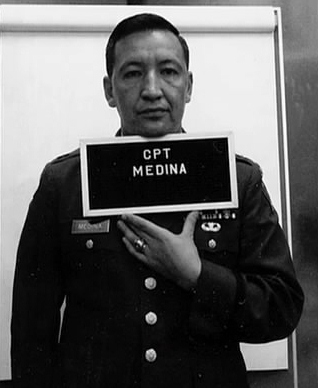
Charlie Company Commander at My Lai
Captain, Commander of Charlie Company, 1st Battalion, 20th Infantry Regiment, Americal Division
Captain Ernest "Mad Dog" Medina commanded Charlie Company, 1st Battalion, 20th Infantry Regiment during the My Lai massacre on March 16, 1968. As the company commander, Medina gave the pre-operation briefing to his troops on the evening of March 15, 1968, in which he conveyed orders for the assault on the Son My village area. The content of this briefing became one of the most contested facts of the My Lai case. Multiple soldiers testified that Medina ordered them to kill everything in the village, including women, children, and animals, and to destroy all structures and food supplies. Medina denied giving explicit orders to kill civilians, claiming he ordered his troops to engage the enemy and destroy the village but not to execute noncombatants. During the massacre itself, Medina remained in the village and, by his own admission, shot at least one Vietnamese woman at close range, though he claimed he believed she was reaching for a weapon. Witnesses testified that Medina personally killed additional civilians and that he was aware of the mass killings occurring throughout the hamlet but did nothing to stop them. Medina was charged with the overall responsibility for the murder of 175 Vietnamese civilians, but was acquitted by court-martial in September 1971 in a verdict that shocked many observers. His defense attorney, F. Lee Bailey, argued that Medina could not be held responsible for actions he did not directly witness or order. After his acquittal, Medina left the Army and lived quietly in Marinette, Wisconsin, working in various civilian jobs. His case became a landmark in military law regarding command responsibility.
The Pre-Operation Briefing: On the evening of March 15, 1968, Medina briefed Charlie Company on the next day's operation. Multiple soldiers testified that Medina told them to kill everything that moved in the village, including women, children, and livestock. Medina denied giving explicit orders to kill civilians, leading to the central dispute of the My Lai case.
Personal Killing of Vietnamese Civilian: Medina admitted to shooting a Vietnamese woman at close range during the operation, claiming he thought she was reaching for a weapon. Other witnesses testified that the woman was unarmed and posed no threat. This admission made Medina one of the few officers to acknowledge personally killing a civilian.
Failure to Stop the Massacre: Even accepting Medina's claim that he did not order the killing of civilians, witnesses testified that he was present in the village during the massacre and was aware of the mass killings occurring. As company commander, he had both the authority and the duty to order a cease-fire and stop the killing, but he took no meaningful action to halt the massacre.
Court-Martial and Acquittal: Medina was charged with responsibility for the murder of 175 Vietnamese civilians as the commanding officer. Leading defense attorney F. Lee Bailey represented him, arguing that command responsibility required direct knowledge and failure to act, which could not be proven beyond reasonable doubt. Medina was acquitted in September 1971.
Falsification of Body Count: After the operation, the official after-action report from Charlie Company claimed 128 enemy killed in action against only 3 weapons recovered. As company commander, Medina bore direct responsibility for these grossly falsified reports that characterized a civilian massacre as a successful combat engagement.
"Mad Dog" Reputation: Medina was known to his troops by the nickname "Mad Dog" for his aggressive leadership style. His emphasis on body counts and aggressive patrolling reflected the broader command culture in Vietnam that prioritized kill statistics over civilian protection.
Paul Meadlo's Accusation: After losing his foot to a land mine the day after the massacre, PFC Paul Meadlo screamed at Medina: "God punished me, and God will punish you." Meadlo later testified on CBS that Medina's briefing left no doubt that they were to kill everyone in the village.
Post-Acquittal Life: After acquittal, Medina resigned from the Army and moved to Marinette, Wisconsin, where he worked in various civilian jobs. He rarely spoke publicly about My Lai and lived in relative obscurity until his death in 2018 at age 81.
1 documented violations
UCMJ Article 118 - MurderPlatoon leader who executed Medina's alleged orders at My Lai
Helicopter pilot who tried to stop Medina's company from killing civilians
Journalist who exposed the My Lai massacre
Task Force Barker commander who gave Medina his operational orders
Charlie Company soldier who accused Medina and testified on CBS
6 documented sources from official records, investigations, and reports
August 27, 1936
Born in Springer, New Mexico
1964
Commissioned as Army officer through Officer Candidate School at Fort Benning
1967
Deployed to Vietnam as commander of Charlie Company, 1st Battalion, 20th Infantry Regiment
March 15, 1968
Briefed Charlie Company on the operation against Son My village, content of briefing disputed as possible kill order
March 16, 1968
Led Charlie Company into My Lai hamlet; massacre of 347-504 civilians occurred under his command
March 16, 1968
Acknowledged shooting at least one Vietnamese woman; witnesses testified he killed additional civilians
November 1969
My Lai massacre publicly exposed by journalist Seymour Hersh
1970
Peers Commission found Medina bore significant responsibility for the massacre
September 22, 1971
Acquitted by military court-martial of responsibility for 175 civilian deaths; defended by F. Lee Bailey
1971
Resigned from the Army and moved to Marinette, Wisconsin
May 8, 2018
Died at age 81 in Marinette, Wisconsin